
How do I choose a repository for sharing and/or archiving my data?
NewSeveral factors should be considered when selecting a repository to share and archive your data.
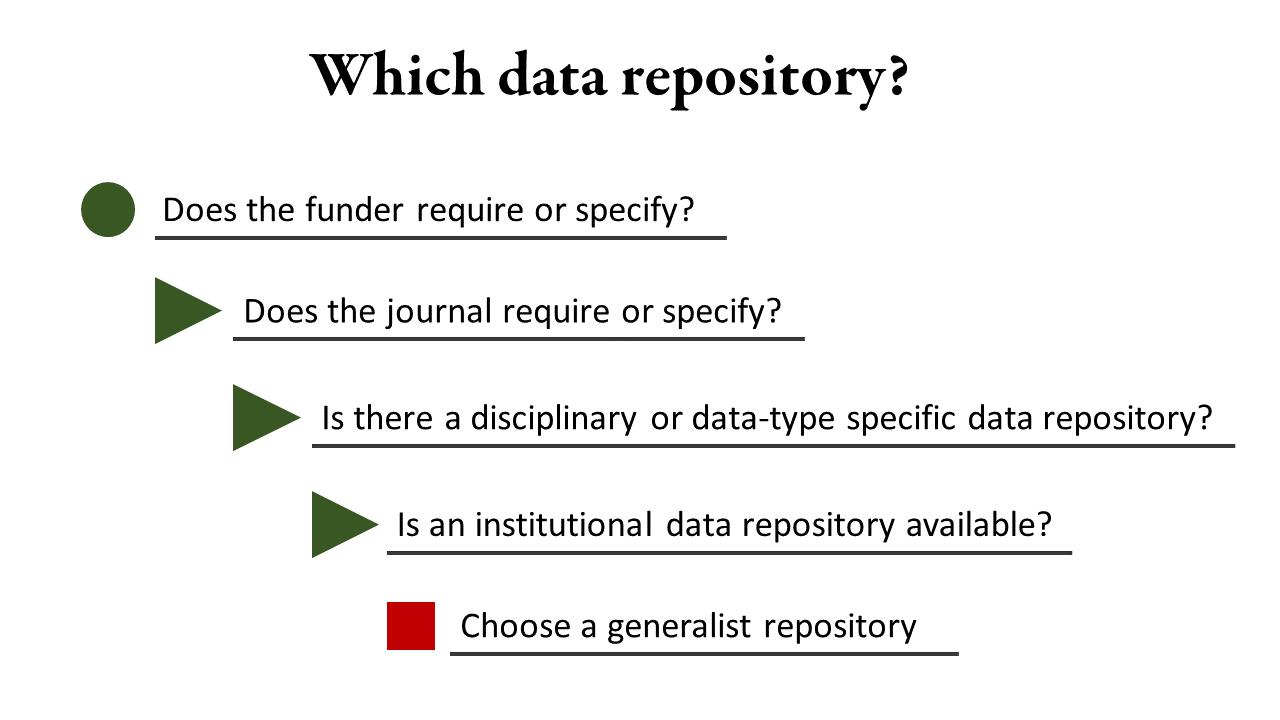
Best practices for choosing a repository vary, but in general, researchers are encouraged to use (1) specific or required repositories (if applicable), (2) subject-specific repositories, (3) institutional repositories, or (4) generalist repositories, in that order.
Below is a flowchart prepared by the IU Research Data Steward that advises how to choose which type of repository to utilize in sharing your data.
Specific or Required Repositories
If your research funder or sponsor requires a specific database to store and share your data, then use the repository specified by your funder or sponsor.
Subject Specific Repositories
If your funder or sponsor does not require a specific repository, there are many specialized databases that you can use to store your data based on your discipline of research. One way to find a specialized database is through the RCRegistry of Data Repositories (re3data.org)Re3data is a global registry of research data repositories RC Registry of Data Repositories (re3data.org) Re3data is a global registry of research data repositoriesRegistry of Data Repositories (re3data.org) , which aggregates data repositories by domain. You can also use the RCData Repositories DirectoryList of repositories and databases for open data RC Data Repositories Directory List of repositories and databases for open dataData Repositories Directory to find lists of active repositories by subject. One major repository that Indiana University belongs to that serves a broad research community is the RCUniversity of Michigan’s ICPSR (Inter-university Consortium for Political and Social Research) repositoryProvides a social science data archive & research methods training RC University of Michigan’s ICPSR (Inter-university Consortium for Political and Social Research) repository Provides a social science data archive & research methods trainingUniversity of Michigan’s ICPSR (Inter-university Consortium for Political and Social Research) repository for social and behavioral research.
Institutional Repositories
Institutional repositories are general repositories that serve an institutional community. RCIU DataCOREProvides access & preservation services for digital research data RC IU DataCORE Provides access & preservation services for digital research dataIU DataCORE is a repository hosted by Indiana University Libraries and serves IU Bloomington, IU East, IU Kokomo, IU Northwest, IU South Bend, and IU Southeast. RCIU Indianapolis DataWorksRepository for preserving and sharing IUI digital research data RC IU Indianapolis DataWorks Repository for preserving and sharing IUI digital research dataIU Indianapolis DataWorks serves the IU Indianapolis community.
You can find additional information regarding repositories and how to make your data accessible through the RCIU Libraries Open Data WebsiteBenefits to open data RC IU Libraries Open Data Website Benefits to open dataIU Libraries Open Data Website .
For more information about data sharing options, see the RCData Sharing PathwaysOptions for sharing data research for reuse RC Data Sharing Pathways Options for sharing data research for reuseData Sharing Pathways webpage, which presents options for sharing research data for reuse via deposit into one or more data repository(ies).
General Repositories
There are several general repositories available to store and share your data. The Generalist Repository Comparison Chart can help you compare the features of various generalist repository options to determine which is best suited for your data needs. Examples include RCFigshareRepository that stores any type of file and visualizes hundreds of file formats RC Figshare Repository that stores any type of file and visualizes hundreds of file formatsFigshare , RCZenodoRepository build and developed by researchers RC Zenodo Repository build and developed by researchersZenodo , and RCDryadOpen data publishing platform RC Dryad Open data publishing platformDryad . The IU Indianapolis University Library has also created a Recommended Generalist Data Repositories graphic that compares several recommended options to help you determine which one to choose. You can view the chart below or visit the Data Repository Library Guide for additional information.

For more information about data sharing options, see the RCData Sharing PathwaysOptions for sharing data research for reuse RC Data Sharing Pathways Options for sharing data research for reuseData Sharing Pathways webpage, which presents options for sharing research data for reuse via deposit into one or more data repository(ies).
There are several key features to consider when selecting a repository to use.
The NIH offers a list of RCDesirable Characteristics for All Data RepositoriesList of desirable characteristics to look for when choosing a repository RC Desirable Characteristics for All Data Repositories List of desirable characteristics to look for when choosing a repository Desirable Characteristics for All Data Repositories to look for when considering repository options:
- Long-term sustainability
- Metadata
- Curation & quality assurance
- Free & easy access
- Broad & measured reuse
- Clear user guidance
- Security & integrity
- Confidentiality
- Common format
- Provenance
- Retention policy
Ensuring data and metadata follow FAIR Guiding Principles:
- Findable
- Accessible
- Interoperable
- Reusable
Yes, researchers can deposit the same dataset in multiple repositories; however, this approach should be done strategically and transparently to avoid confusion, versioning issues, or noncompliance with repository or funder policies. At Indiana University, data librarians generally recommend that researchers identify one authoritative version of the dataset, but there are legitimate scenarios where a secondary deposit, often referred to as “dual deposit”, is appropriate and even advisable.
Two key reasons to consider depositing in more than one location are redundancy and preservation. For example, if a researcher deposits data in a federally funded or domain-specific repository that meets funder requirements (e.g., GenBank, ICPSR, NIH dbGaP), they might also create a backup copy in IU’s RCScholarly Data Archive (SDA)Storage services that enable short and long term storage for research computing RC Scholarly Data Archive (SDA) Storage services that enable short and long term storage for research computingScholarly Data Archive (SDA) to guard against the risk of deprecation, defunding, or service disruptions. Another practice, especially in the case of repository uncertainty, is to deposit in both a disciplinary repository and an institutional repository, such as RCDataCOREProvides access & preservation services for digital research data RC DataCORE Provides access & preservation services for digital research dataDataCORE (IUB) or RCDataWorksRepository for preserving and sharing IUI digital research data RC DataWorks Repository for preserving and sharing IUI digital research dataDataWorks (IUI) to improve long-term accessibility and institutional stewardship.
Researchers should avoid indiscriminate or uncoordinated duplication across multiple repositories, as this can create confusion about which version is definitive, especially when RCDOIsMints DOIs for scholarly work deposited in DataCore & IUScholarWorks RC DOIs Mints DOIs for scholarly work deposited in DataCore & IUScholarWorksDOIs or metadata differ. It is also important to check the terms of service for each repository, as some (particularly those in commercial or international settings) may place restrictions on redistribution. Before pursuing multi-repository deposit, IU researchers are encouraged to consult with RCdata librariansContact information for IU Research Data Services Librarians RC data librarians Contact information for IU Research Data Services Librariansdata librarians , who can help determine the most appropriate deposit strategy, ensure proper version control, and avoid unintended policy or licensing conflicts.
The potential defunding or shutdown of a data repository is a growing concern in the research community. If a repository becomes inaccessible, researchers risk not only losing access to their data but also the ability for others to find, cite, and reuse it, which impacts reproducibility, compliance, and scholarly visibility. To mitigate this risk, researchers at Indiana University are encouraged to adopt redundant data preservation strategies and proactively plan for repository instability.
The first line of defense is to maintain a secure backup copy of any data deposited into an external repository. IU researchers can use the RCScholarly Data Archive (SDA)Storage services that enable short and long term storage for research computing RC Scholarly Data Archive (SDA) Storage services that enable short and long term storage for research computingScholarly Data Archive (SDA) as a long-term, institutionally supported storage solution for this purpose. SDA is designed for preservation, not public access, so it provides a safeguard without creating confusing duplication in the public domain. By storing a full, fixed copy of a dataset, including any documentation or code, researchers ensure that the data remains accessible and re-shareable if the primary repository becomes unavailable.
Additionally, IU’s RCDataCOREProvides access & preservation services for digital research data RC DataCORE Provides access & preservation services for digital research dataDataCORE (IUB) and RCDataWorksRepository for preserving and sharing IUI digital research data RC DataWorks Repository for preserving and sharing IUI digital research dataDataWorks (IUI) repositories can serve as either primary or secondary deposit locations. For example, if a researcher deposits data in a domain-specific or federal repository (e.g., RCICPSRProvides a social science data archive & research methods training RC ICPSR Provides a social science data archive & research methods trainingICPSR , RCDryadOpen data publishing platform RC Dryad Open data publishing platformDryad , or an RCNIH supported repositoryBMIC maintained lists of domain-specific & generalist data sharing repositories RC NIH supported repository BMIC maintained lists of domain-specific & generalist data sharing repositoriesNIH supported repository ), they may also create a metadata-only record with a RCDOIMints DOIs for scholarly work deposited in DataCore & IUScholarWorks RC DOI Mints DOIs for scholarly work deposited in DataCore & IUScholarWorksDOI in one of IU’s repositories. This ensures that the dataset remains discoverable and citable, even if the external service becomes unstable or permanently unavailable. In the event of a shutdown, researchers can update the DOI or metadata record to point to the backup copy stored at IU, preserving access and scholarly continuity.
Finally, IU data librarians can assist with transition planning and repository evaluations. If researchers become aware that a repository they use is at risk, or if they receive notification of changes to access policies or infrastructure, they should immediately contact the repository for guidance. IU’s support teams can help extract data before shutdown, prepare a replacement deposit, and maintain data availability statements in line with funder or publisher requirements. Taking these proactive steps ensures that research outputs remain accessible, reliable, and preserved, regardless of external disruptions.